


Game info
Arcade, Growth
Learn original Hole.io gameplay, swipe movement, black-hole growth, target selection, object alignment and efficient city-clearing routes.
Hole.io: Grow from Small Objects to a Whole Neighbourhood
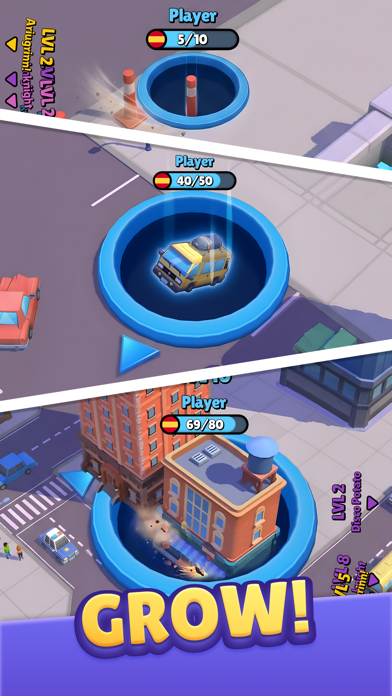
Hole.io makes a city into a growth puzzle: move a black hole beneath objects that fit, swallow them and use the larger opening to consume something more ambitious. The satisfying moment is the change in scale. A route that began with small street clutter can later include cars and buildings that were out of reach at the start.
Voodoo’s original Hole.io is built around that expanding appetite. Each growth step changes which parts of the environment are useful, so a good route develops rather than remaining a fixed tour of the map. The practical tactics below focus on the decisions that create steady progress: choose suitable targets, clear a compact route, align awkward shapes and reconsider the neighbourhood whenever the hole becomes larger.
Gameplay Overview
Growth changes which parts of the environment are useful. At a small size, a large building is mainly something to navigate around. After enough successful swallowing, that same area can become a valuable destination. The best route therefore changes during the round rather than remaining a fixed tour of the map.

Watch the opening, not just the object’s visible height. A target needs to fit through the hole’s effective width, and an awkward object can need better alignment before it falls. If you keep circling something without gaining progress, move to easier targets rather than spending the whole attempt proving that it should fit. The immediate goal is a sequence of successful consumptions that creates the next size increase. That increase gives you a reason to revisit the object later.
How to Play: Build an Opening Route
Start with a compact patch of small objects near your spawn. Move beneath one suitable target, observe how it drops and continue to the next nearby object. This opening gives you growth without paying for a long journey through empty streets. A cluster is useful because the next target is ready as soon as the previous one disappears.
After growing, widen the route gradually. Test a slightly larger object near the area you have already cleared, then decide whether the new size makes another local cluster worthwhile. For example, small street items can lead to a line of larger roadside targets before you commit to crossing the map. Avoid spending the opening chasing a distant building. If the hole is still too small when you arrive, the travel has added no useful growth.
Controls and Movement
Hole.io uses swipe-and-glide movement to position the black hole beneath objects. Begin with a short movement, stop over a small target and check how the opening lines up beneath it. Accurate positioning matters because a fast pass across an object may not leave it enough time to fall.
The official Hole.io App Store listing describes the original game’s simple movement and growth. In play, the important skill is controlling the approach. Slow the movement while centring a narrow target, then leave cleanly for the next one. Keep your hand from hiding the opening or the nearby object you intend to consume. A smooth route makes it easier to recognise whether resistance comes from poor alignment or the hole still being too small.
Pro Tips: Reassess after Growing
A growth step is a signal to reassess nearby targets. Do not automatically repeat the same circuit of tiny objects after the hole becomes large enough for something better. Look at the closest object class that previously resisted you and test it once with a centred approach.
Useful Hole.io tips include:
- Clear dense groups of objects that already fit.
- Try larger targets after visible growth, not after every failed pass.
- Approach awkward shapes from an angle that places their width over the opening.
- Leave a stubborn target after one careful alignment attempt.
- Include travel time when comparing two promising areas.
The advantage comes from keeping the route productive. A slightly smaller cluster close by can produce more useful growth than a rich-looking district separated from you by a long stretch of already empty ground.
Key Features
Hole.io combines a growing black hole with environments full of changing size thresholds. A small roadside item may be an opening target, while a building becomes useful only after enough growth. The same map therefore asks different questions during the run: first what fits, then which larger objects can be consumed efficiently.
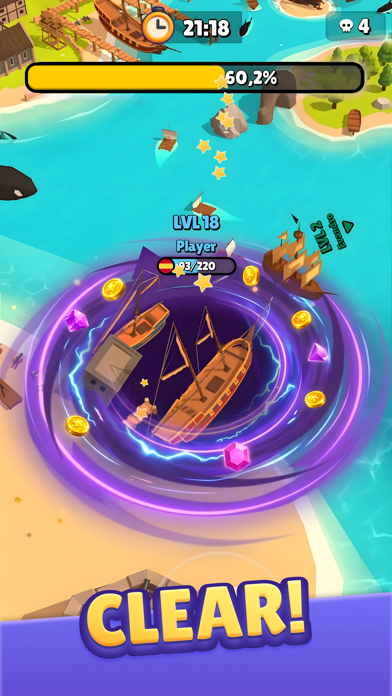
The original app presents themed environments as part of that swallowing activity, including city, pirate and futuristic settings in its current store description. Different scenery can change how targets are distributed and how much empty travel lies between them. Keep the same practical approach across the setting: find an accessible cluster, use successful consumption to reach the next size and check what that growth unlocks nearby. The most impressive structure is useful only when the hole can turn it into actual progress.
Plan in Clusters, Not Isolated Targets
A cluster is more than a collection of points on a map. It gives you several consumable objects with little movement between them. Compare a line of small street items with an isolated object of a similar size across a wide road. Even if the isolated object looks valuable, the line can keep your hole feeding continuously while the long trip produces nothing.
Build a route through the cluster rather than weaving randomly among its edges. Start at one end, clear a short sequence and use the final position to approach the next group. If growth occurs partway through, check whether the larger opening can take an adjacent object before leaving. This makes the route responsive: you retain the efficiency of the cluster without ignoring a new target that has become available beside it.
Solve Awkward Objects with Alignment
When a target catches on the edge of the hole, first distinguish alignment from size. Move the opening beneath the centre and make one controlled adjustment. If the object begins to tip or settle, hold a useful position rather than circling continuously. Repeated movement can pull the opening away from the point that was working.
If the target still will not fall, leave it and collect easier objects. A failed attempt is useful information about the current size, not a challenge that needs to consume the rest of the round. Remember its location and return after growing. This is especially helpful near larger structures: an object that seemed awkward at one size may drop readily when the opening becomes wider, allowing the return visit to be much more efficient.
Balance Exploration with a Reliable Route
Exploration is useful when it finds a better feeding area, but it has a cost while you are moving through empty space. Before leaving a productive district, look for a destination rather than drifting toward the most interesting-looking part of the skyline. Try to connect cleared areas with a visible chain of targets that already fit.
If you revisit a route, notice what remains instead of assuming its earlier value. A once-dense cluster may now be empty except for one oversized object. In that case, a nearby unvisited street can be a better choice than another complete lap. Good Hole.io route planning balances familiarity with opportunity: use remembered locations to reduce wandering, but update the plan whenever consumption or growth changes what the area can provide.
Rivals, Timers and Round Objectives
A timer changes the value of travel and hesitation in Hole.io. An empty crossing costs part of the round, while a dense nearby cluster can keep the hole growing continuously. Read the stated activity objective before choosing a route: a race for score and an environmental clearing task can reward different priorities.
When rival holes affect the round, watch which areas they are clearing instead of assuming every visible cluster will remain available. If the objective emphasises clearing, move through a district systematically so that you know what remains. The official Hole.io Android listing provides current product and app information. During a run, let the objective and remaining targets decide the next destination. A route should be judged by the successful consumptions it produces, not only by how far it travels.
A Focused Practice Challenge
Choose a recognisable local landmark and try to reach the next size increase while remaining near it. Use the small targets in that area, then test one nearby larger object after growing. The exercise teaches which target groups are productive without turning the whole attempt into an unfocused tour.
On the next run, compare a different opening route of similar length. Did it reach useful growth sooner? Did you waste time on something that was still too large? Did the final position lead toward more food or an empty crossing? Those comparisons are more helpful than judging only the final hole size. You are learning a sequence of targets that can be completed smoothly, which gives later rounds a more reliable start.
Advanced Tips: Learn from the End of a Route
At the end of a route, look for the first long stretch that produced no successful consumption. It may have been travel toward an oversized building, repeated alignment attempts or a return through an area you had already emptied. Each suggests a different correction for the next attempt.
For wasted travel, choose a visible target chain before leaving the current cluster. For a stubborn object, limit the alignment test and return after growth. For an empty repeat circuit, remember which side of the landmark you cleared and approach a new street. This turns an apparently casual swallowing game into a readable planning challenge. Your next route is not simply faster movement; it removes one known interruption from a sequence that already contains useful food.
Similar Games to Try
Hole.io’s growing-hole mechanic combines object collection with route planning and size judgements. Those are useful qualities to look for in another collecting game. A familiar kind of target can still ask for a different approach when the map places clusters farther apart or crowds them into narrow streets.
The related-game collection below provides more environmental collecting and growth activities. Choose a title according to the part of the problem you enjoy, such as centring objects, clearing a district or reacting to rivals in an arena. Start with a small target test and learn how consumption changes the size of the player object. Then connect the successful targets into a route instead of drifting randomly around the most interesting-looking scenery.
Browser games in this collection
- Sinkhole Rush — A city-swallowing sinkhole game where size determines which objects can be consumed. It is a separately listed browser alternative to Hole.io.
- Hoard Master Online — A hole-based collecting game whose catalogue connects swallowing objects to upgrade and construction play. Exact upgrade rules remain build-specific.
- Holey.io Battle Royale — A swallowing-hole arena with growth, collectible boosts and a shrinking safe-zone rule described by its source.
- Stickhole.io — A hole-collection game that gathers stick figures into a group for a later boss encounter.
- Hole Eat Grow Attack — A hole arena combining object and ammunition collection, rival-hole attacks, and source-described solo or two-player rounds.
- Hole And Fill Collect Master — A swallowing-hole collection game focused on eating food items and growing enough to collect larger pieces.
Choose a Route for the Objective
The round’s objective determines which route is useful. For a short timer, prioritise dense groups with little travel and leave awkward objects quickly. For a clearing objective, work through a district systematically so that you can tell what remains. If rivals influence the round, avoid treating an exposed feeding area as guaranteed food merely because it looked clear a moment ago.
A good route also needs a useful ending. Clearing a small cluster beside another productive street can be better than taking a slightly larger object that leaves you isolated. Before committing, glance at the next destination. Planning that extra step reduces the common pause after growth when the hole is larger but the player has not decided where to go.
History, Updates and Progression
Hole.io is part of Voodoo’s game catalogue. The original game builds a recognisable progression from a tiny hole and small street objects to a much larger opening capable of consuming the surroundings. Its maps and presentation can change through updates, while that size-and-route relationship remains central to the activity.
Keep unlocks and appearance choices separate from the immediate movement problem. A new look can add variety, but successful swallowing still depends on suitable targets and positioning. Use the official product and store information for current features instead of relying on a fixed list of temporary rewards. For practical play, remember which object groups were efficient at an early size and where the following cluster was located. That route knowledge gives the next attempt a more reliable beginning.
Finish with a Clear Next Goal
Begin the next Hole.io round by finding several small objects close together. Centre the opening, consume the first target and continue through the cluster before making a long trip. When the hole grows, check what that size makes possible in the same neighbourhood.
Give the following attempt one clear improvement: fewer passes around a stubborn object, less empty travel or a better first destination after growing. The game becomes more readable when a familiar district turns into a sequence you can clear efficiently. Keep the movement controlled, let successful consumptions drive the route and save the biggest-looking structures for the moment when the hole can actually swallow them. A reliable chain of targets gives you more useful progress than a long journey toward something that still does not fit.
Frequently asked questions
Who publishes Hole.io?
Voodoo publishes the original Hole.io game and provides its official product and app information.
How do you grow in Hole.io?
Move beneath objects small enough to fit in the opening. Successful consumption increases the hole’s size and makes larger objects worth trying.
What are the original Hole.io controls?
Swipe and glide to move the black hole under objects. Use controlled movements when centring a narrow or awkward target.
Why will an object not fall into the hole?
It may be too large or poorly aligned. Centre the opening once and make a careful adjustment. If it still resists, collect easier targets and return after growing.
How should I respond to rival holes?
Notice which areas they are clearing and choose a productive route rather than following every rival. Keep a nearby chain of targets available for your own growth.
Is the original Hole.io free to install?
Its official mobile listings offer free installation with optional purchases. The Android listing also identifies advertising.
How do different maps affect Hole.io strategy?
Target density and travel distances can change. Use compact accessible clusters, then reassess nearby larger objects whenever the hole grows.
What is a useful beginner strategy?
Clear a dense nearby group of objects that already fit. Avoid spending the opening travelling to a large structure the hole cannot yet consume.


Good game? Tell us.0
Share a tip, celebrate a high score, or tell us what you think. Keep it friendly.